

ROS Learning Practice: Read Bag Metadata Before Replay
2026-11-02
ROS Learning Practice: Read Bag Metadata Before Replay
Bag metadata can help a ROS learner understand what a recording describes before deciding whether replay belongs in the lesson. This practical article proposes a read-only exercise for ROS 2 Jazzy using instructor-prepared material. It does not open a recording, publish messages, connect to equipment, or reproduce a real experiment. The learner first distinguishes a description of a file from an observation of messages or behavior.
Explain the learning question before selecting an activity
Imagine a class whose immediate task is to identify the subjects represented in a teaching recording. That question can be discussed separately from making a simulation move. The instructor should state the intended observation so learners do not assume that every recording exercise requires playback.
Keep the prepared material and its stated purpose together. If the instructor has not supplied an authorized recording, the exercise can remain a reading plan. It should not acquire invented file names, durations, or message counts simply to look complete.
A useful first question is what the learner expects to know after reading metadata. The answer should concern the description available from that observation. It should not promise that the learner will understand every message or prove how a robot behaved.
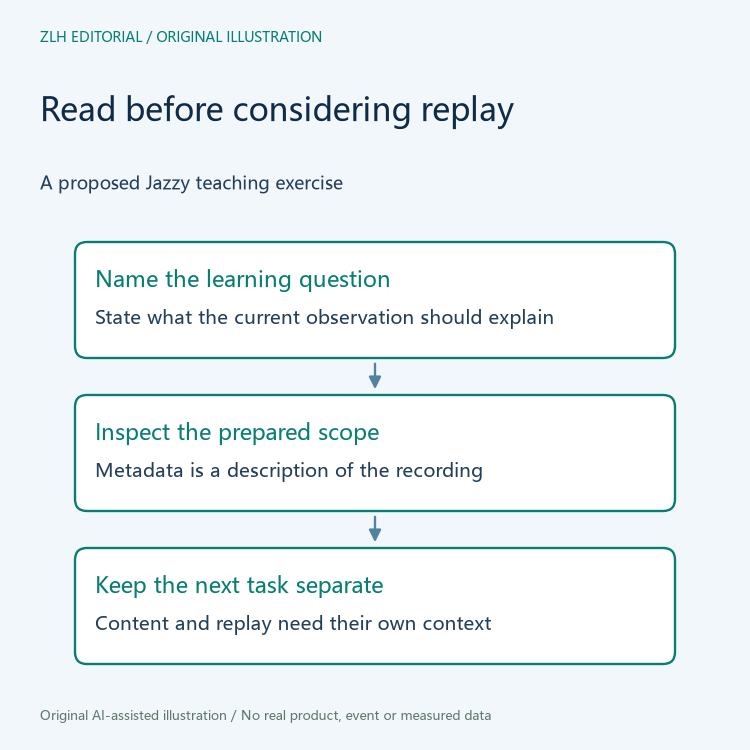
Read metadata as a description with a stated scope
The Jazzy recording tutorial distinguishes inspecting a bag from playing its data. For the fictional lesson, the learner should identify which activity is being discussed and which information it is intended to provide.
When an instructor actually prepares a read-only inspection, the learner can explain the kinds of fields observed, such as topic-related descriptions and the recording’s scope. The exact values must come from the actual prepared material, not from a documentation example copied into a new report.
The instructor can also ask whether a description concerns the whole recording or a selected topic. Learners should name that scope before combining descriptions, rather than treating every item in a metadata report as interchangeable evidence.
This article supplies no inspection transcript. It also does not infer that a topic description proves its messages are suitable for a later task. A description can help formulate the next question while leaving content interpretation open.
Keep message content and behavior as separate questions
A learner may want to know what an individual message means. That is narrower than a general file description and needs an appropriate observation. The class should explain the question before treating a metadata list as a complete account of the content.
The official rosbag2 repository documents recording and replay facilities. Their availability does not establish that replay has occurred in this lesson. Nor does it establish that a particular receiving environment will behave as a learner imagines.

If a later instructor-led lesson includes replay, its prepared environment and intended observations should be explained separately. This article does not arrange that activity or give instructions for replaying into a live robot system. The present exercise remains read-only.
A simulation response would also be an observation in that specific lesson, rather than proof of an original physical event. The instructor should keep the recording’s origin, the received messages, and the observed response distinguishable when those questions are actually examined.
Use missing information to narrow the next task
Suppose the fictional learner cannot answer a content question from the metadata. The useful response is to name what is missing and ask which authorized next observation could address it. A gap should not be filled with a plausible story about the recording.
The same applies if prepared material cannot be inspected as expected. Preserve the original and ask the instructor to review the classroom context. The article has no real error to diagnose and does not recommend converting, modifying, or re-recording a file merely to obtain a success label.
A narrow next question is easier to teach than an undifferentiated request to prove that a recording works. It tells learners which evidence is relevant and which conclusions remain outside the current exercise.
Ask another learner to identify the observation level
At the end, a colleague should be able to say whether each proposed statement concerns metadata, message content, or observed behavior. If the statement crosses levels without explanation, revise it. The exercise succeeds by making the questions clear, not by manufacturing a playback result.
A short summary can preserve the learning purpose, the actual material inspected if any, and the unresolved content questions. It should not turn a read-only activity into an assertion of reproducibility or equipment performance.
More lessons appear in our robot learning pathways section and the article directory. Both original illustrations are conceptual, with no actual bag, message counts, topic list, replay trace, or simulated result.


