
Saffman Lift: Separate Slip, Shear and Particle Size
2026-11-26
Saffman Lift: Separate Slip, Shear and Particle Size
Saffman lift describes a slip-shear contribution to the force on a small particle moving through an ideal viscous shear flow. In a manufacturing slurry-model review, a fluid velocity gradient and a particle’s relative velocity are separate inputs. The small-particle expression does not describe every lift mechanism in a channel, especially near walls. A useful arithmetic check retains those distinctions before interpreting a calculated lateral force.
Use a radius and a relative velocity consistently
Consider a rigid spherical particle in an unbounded simple shear flow, far from walls, with particle rotation neglected in the stated idealization. Let a denote particle radius, rho fluid density, mu dynamic viscosity and nu equal to mu divided by rho. Let G denote the magnitude of the shear rate, with units of reciprocal seconds. Let V denote the magnitude of fluid velocity relative to the particle at its center.
The corresponding Saffman magnitude is F equal to 6.46 rho a squared V times the square root of nu G, equivalently 6.46 a squared V times the square root of rho mu G. The numerical coefficient accompanies the radius-squared convention used here. If a diameter d is used instead, a squared becomes d squared divided by four. Keeping the same coefficient with an unadjusted diameter squared would multiply the result by four incorrectly.
Separate the force direction from its magnitude
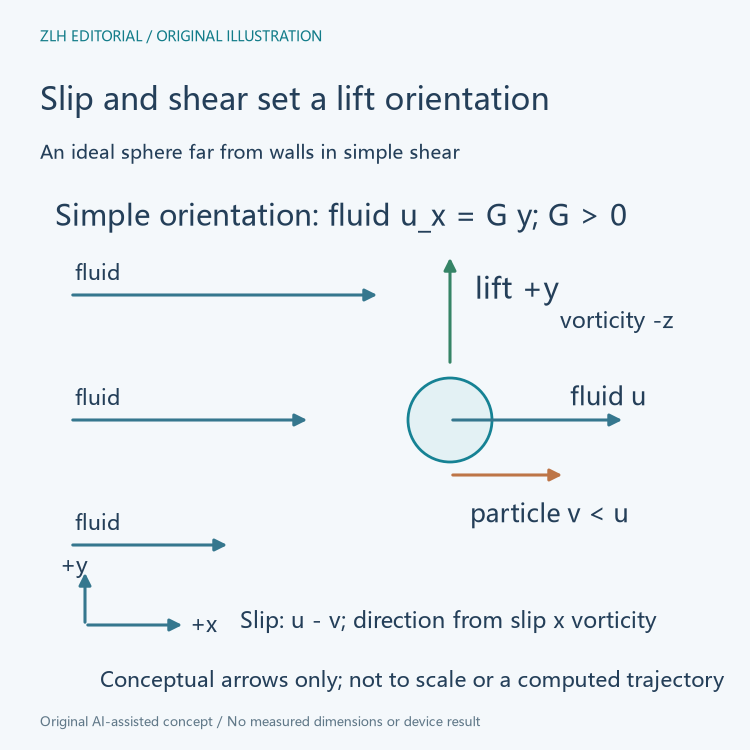
A magnitude equation uses absolute values and therefore does not define the direction by itself. In the simple nonrotating-particle setting, the vector expression involves relative velocity crossed with fluid vorticity. Reversing the relative velocity reverses this lift contribution when the shear is held fixed. Reversing the shear also changes the relevant direction. The slip and shear therefore need their own signed definitions in a vector implementation.
For a conceptual orientation, let the undisturbed fluid velocity point along positive x and increase with y. A particle moving more slowly than the fluid at its center has positive fluid-minus-particle slip along x. The associated vorticity points along negative z, and their cross product points along positive y. The original diagram marks only this ideal orientation; it is not a computed trajectory or a measured flow image.
Calculate an independent small-parameter example
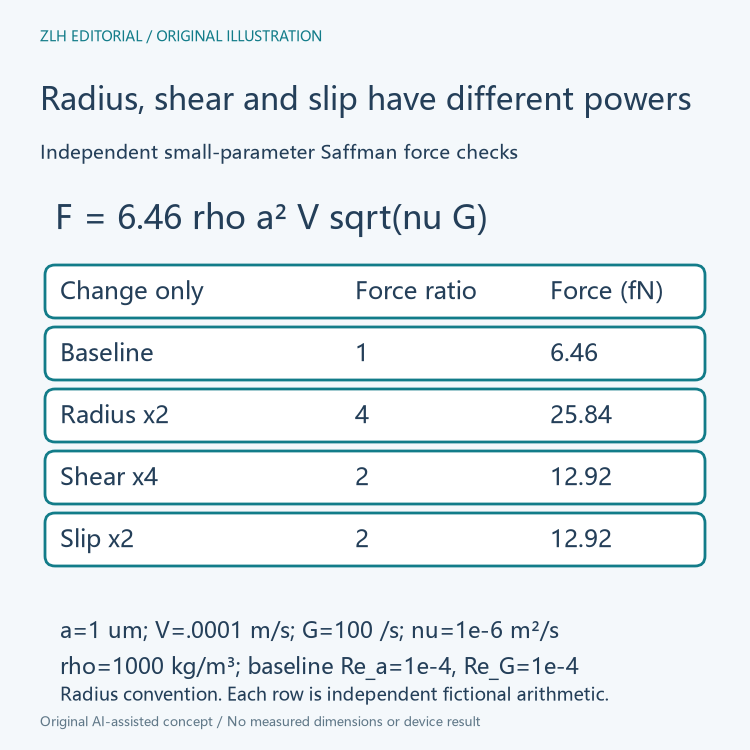
Choose fictional rho equal to one thousand kilograms per cubic metre and nu equal to one millionth of a square metre per second, giving mu equal to 0.001 pascal seconds. Choose a equal to one micrometre, V equal to 0.0001 metre per second and G equal to one hundred per second. These values form an arithmetic dataset, not a recommended slurry or particle-processing condition.
The square root of nu G is 0.01 metre per second. Substitution gives F equal to 6.46 times ten to the negative fifteenth newtons. Its force unit follows from density times area times velocity squared. Mixing micrometres with metres inside a squared radius would create a substantial unit error; the radius must first be converted to one millionth of a metre.
Check the assumptions before changing an input
Using radius-based definitions, the slip Reynolds number a V divided by nu is 0.0001 in this example. The shear Reynolds number a squared G divided by nu is also 0.0001, whose square root is 0.01. Both are small, and the slip Reynolds number is much smaller than the square root of the shear Reynolds number. These checks describe the asymptotic ordering associated with this ideal expression, with the definitions stated explicitly.
Keeping all other inputs fixed, doubling radius multiplies this force magnitude by four. Multiplying G by four doubles the force, while doubling the slip speed doubles it. A zero slip speed removes this particular contribution even if a fluid velocity gradient remains. That last observation does not imply that every form of inertial or near-wall particle lift must vanish under the same circumstance.
Keep a local force check separate from a trajectory model
The official theory distinguishes Saffman lift far from walls from specialized near-wall formulations. A particle-trajectory prediction also requires the other relevant forces, particle inertia, the evolving flow field and appropriate boundary conditions. A local shear estimate alone does not prove a particular migration distance or focusing outcome. Changing the particle size can also change the small-parameter checks, even when the algebraic force scaling is straightforward.
A reproducible record states the radius or diameter convention, fluid-minus-particle velocity definition, local shear or vorticity, material units and range assumptions. The two new illustrations show one ideal orientation and independent magnitude ratios. No particle experiment, simulated slurry field or equipment performance is claimed, leaving the scope of the calculation visible to a subsequent model reviewer.
Primary references and related reading
COMSOL’s original particle-motion-in-shear-flow theory and Sommerfeld’s original university particle-dynamics lecture. See the industry article archive and equipment reference directory for related material.