Plucker Line Coordinates Keep the Moment Independent of Point Choice
2026-11-25
Plucker Line Coordinates Keep the Moment Independent of Point Choice
Plucker Line Coordinates let a robotics geometry record describe a straight line using a direction vector and a moment vector. They avoid making the identity of the line depend on one particular point selected along it. A fitted feature or geometric axis can contain many possible reference points, while remaining the same spatial line. The six stored numbers therefore need interpretation, rather than being treated as six unrelated coordinates of two points.
Build the moment from a point and a nonzero direction
Use a fixed Cartesian frame. Let p be the position vector of a point on the line and let d be a nonzero direction vector. Under the convention used here, the Plucker pair is (d, m), where m = p cross d. The order of this cross product matters: reversing the factors changes its sign. The word moment describes a geometric representation and does not claim that a force was applied to a real robot.
Yan-Bin Jia's original Iowa State line-coordinate notes give this definition and explain why an ordinary spatial line has four geometric degrees of freedom. Six stored components are useful, but they are not six independent parameters. For a finite Euclidean line in this article, d must remain nonzero.
The moment is perpendicular to the direction because a cross product is perpendicular to both factors. Thus d dot m equals zero. This relation is a consistency condition for a valid pair. It is not a test that any arbitrary noisy six-number observation automatically passes without an estimation model or declared tolerance.
Moving the selected point along the line keeps the moment
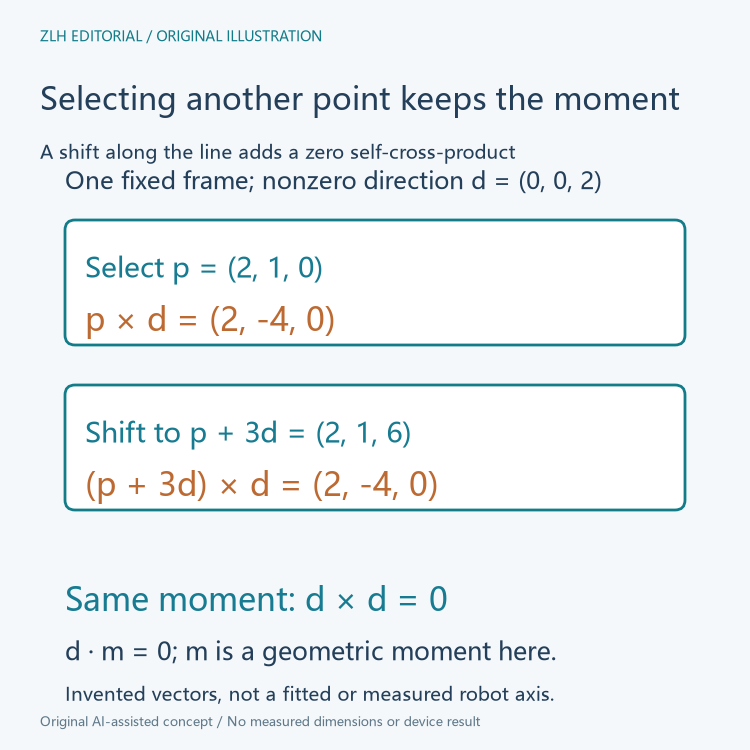
Another point on the same line has position p plus t times d for some scalar t. Its moment is (p + t d) cross d. Expanding produces p cross d plus t times d cross d. The second term is zero, so the result is the original m. A change of selected point along the line therefore leaves both the direction and moment unchanged.
For an independent fictional example, choose p = (2, 1, 0) and d = (0, 0, 2). Their cross product is m = (2, -4, 0). The point p-prime = (2, 1, 6) lies three direction-vector steps farther along the same line. Computing p-prime cross d again gives (2, -4, 0), not a new line moment.
A point off the line fails the same membership relation. For instance q = (3, 1, 0) gives q cross d = (2, -6, 0), which differs from m. This exact arithmetic example uses invented coordinates, rather than a sensor accuracy claim. Floating-point fitted data would require its own uncertainty treatment.
Common scaling preserves the line while normalization changes components
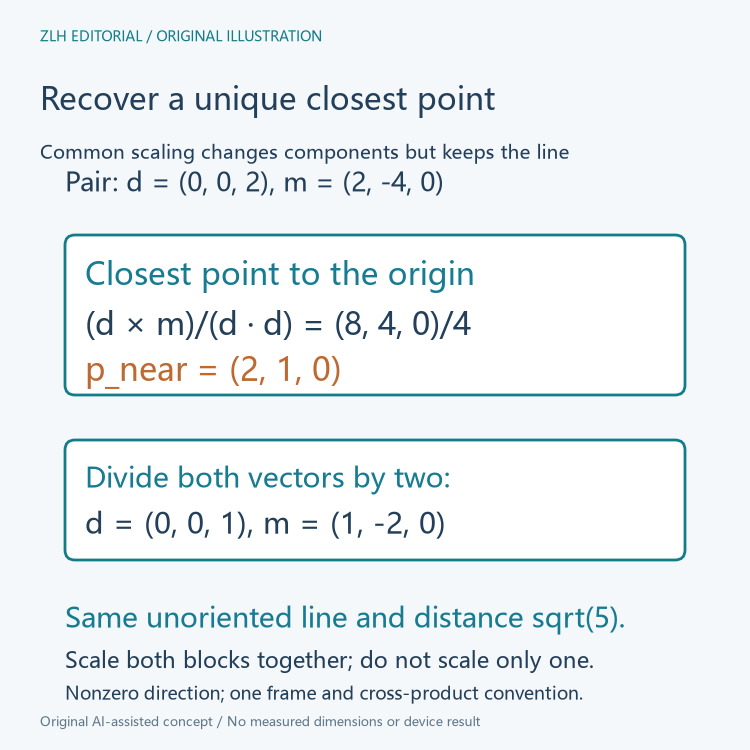
Multiplying both d and m by the same nonzero scalar preserves the represented unoriented line. Scaling only one of them generally does not. In the example, dividing both vectors by two gives direction (0, 0, 1) and moment (1, -2, 0). The coordinates changed, while the underlying vertical line through horizontal position (2, 1) did not.
The original robot kinematics text by Herman Bruyninckx describes direction and moment components, homogeneous scaling, and recovery of the closest point. A record with normalized direction should not be mixed component by component with an unnormalized pair. Distinct input points are needed if a direction is first constructed from two points.
A negative common scale reverses the direction vector as well as the moment. It describes the same underlying unoriented line, but reverses a separately retained orientation convention. A geometry pipeline that attaches travel direction to the line must preserve that extra meaning. Homogeneous equivalence alone does not decide which direction a robot should move.
Recover the closest point without choosing a new arbitrary point
For a general nonzero d, the closest point to the reference origin is p-near = (d cross m)/(d dot d). In the fictional example, d cross m is (8, 4, 0), and d dot d is four. The recovered point is therefore (2, 1, 0). It is perpendicular to the line direction, as required for the closest point.
The origin-to-line distance is the norm of m divided by the norm of d. Here it is square root twenty divided by two, or square root five coordinate-length units. The normalized pair gives the same distance directly from the moment norm. A zero moment with nonzero direction instead represents a line passing through the origin, not a missing line.
These calculations all refer to one fixed frame and one cross-product convention. A stored frame identifier and a declared vector ordering keep the resulting tuple understandable when it is handed to another geometry routine. Changing the reference origin changes position vectors and generally changes the moment. Related explanations appear in robot geometry articles and technical learning references. Both original figures contain exact fictional vector arithmetic; they show neither a measured axis fit nor a motion instruction.