
Restrained Thermal Expansion and Axial Fixture Stress
2026-11-25
Restrained Thermal Expansion and Axial Fixture Stress
Restrained Thermal Expansion concerns what happens when a part cannot take the length change that heating would otherwise produce. For an ideal fixture bar, an unchanged overall length does not imply that every strain contribution is zero. The thermal contribution can be cancelled by an opposing elastic contribution, leaving a nonzero reaction force.
Choose a one dimensional idealization first
Consider a homogeneous straight bar with a uniform small temperature rise. Its axial ends retain their original separation, while transverse surfaces remain free. The material is linear elastic, the temperature change is measured from an initially stress-free state, and both Young's modulus E and expansion coefficient alpha are treated as constant. This is an ideal model for reading a fixture calculation, not a description of an actual assembled device.
Allan Bower's original linear elasticity chapter separates the thermal and elastic contributions to strain. With only axial normal stress, its isotropic constitutive relation reduces to total axial strain equal to sigma divided by E plus alpha times the temperature change.
Compatibility determines which strain is zero
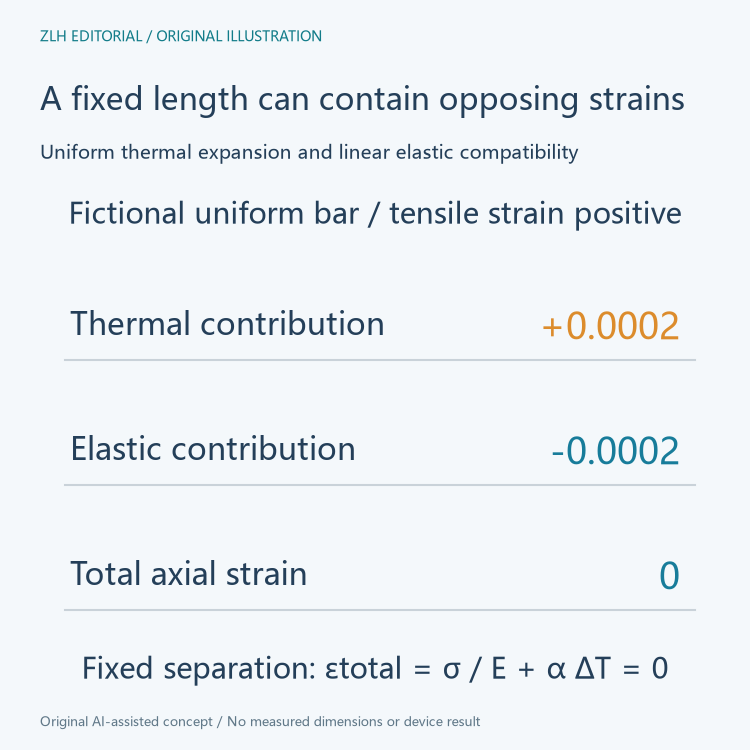
If the bar is free to expand axially, the ideal axial stress is zero and its total strain is alpha times the temperature rise. Its length increases accordingly. If both ends retain exactly the original separation, the total axial strain instead equals zero. Combining that constraint with the constitutive relation gives sigma = minus E alpha DeltaT.
Tension is positive in this article. For positive alpha and heating, the resulting stress is negative, meaning compression. The associated elastic strain is negative and cancels the positive thermal strain. It would be inconsistent to set both contributions individually to zero while retaining a nonzero temperature rise and the same expansion coefficient.
Check an explicitly fictional material record
Choose illustrative values E = 100 gigapascals, alpha = ten millionths per kelvin, and a temperature increase of twenty kelvin. Their product alpha DeltaT is 0.0002. For a fictional reference length of one hundred millimetres, the free increase would be 0.02 millimetres.
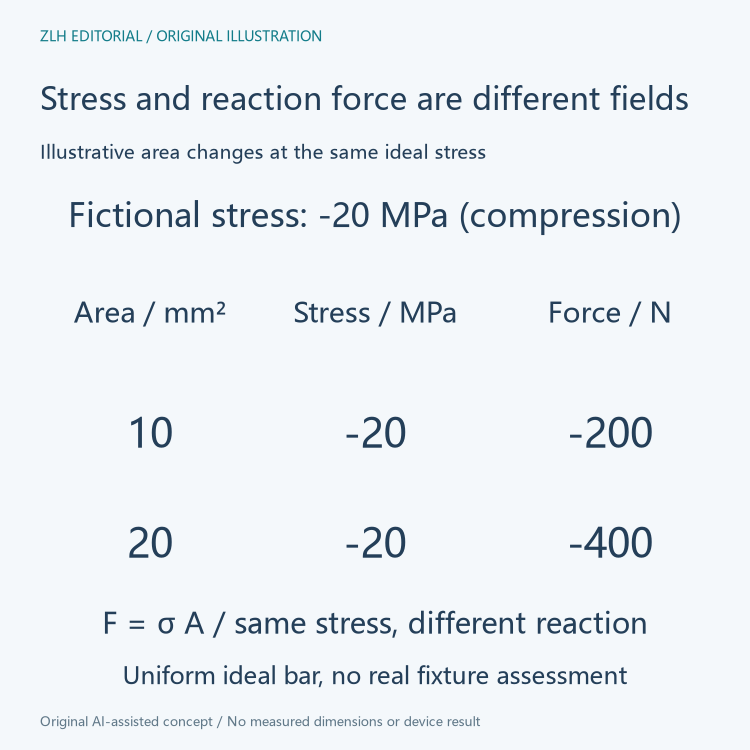
Under the stated complete axial restraint, the elastic strain becomes minus 0.0002 and the axial stress becomes minus twenty megapascals. Those strain contributions add to zero. The values were selected for transparent arithmetic; they are not measured properties or an approved temperature change for a real fixture.
If the illustrative cross-sectional area is ten square millimetres, the axial force magnitude is two hundred newtons. An area of twenty square millimetres would give four hundred newtons at the same ideal stress. Area therefore changes the reaction force, even though it does not appear in this particular fully restrained uniform-bar stress expression.
Length and support motion have different roles
The cancellation of length in the ideal stress expression should not be read as permission to ignore geometry. Free elongation scales with length. If the end separation changes by an independently known small amount delta, the total strain is delta divided by the reference length, and the same constitutive relation gives sigma = E times the difference between that total strain and alpha DeltaT.
This is a compatibility calculation. A support that itself expands, a compliant joint, a gap that remains open, or sliding contact can change the imposed displacement. Treating those conditions as a perfectly fixed separation would be an additional assumption requiring evidence.
Keep the reference temperature and coefficient together
The original COMSOL thermal-expansion documentation explains why thermal strain and its reference state belong together, and distinguishes tangent from secant expansion data. A coefficient copied without its definition and reference temperature may not reproduce the same length change.
The constant-coefficient example above avoids a temperature-dependent integration. It does not establish that an actual coefficient stays constant over an arbitrary range. The same caution applies to the elastic modulus and the assumed initial absence of stress.
One useful unit check writes the illustrative modulus as one hundred thousand newtons per square millimetre. Multiplying it by the dimensionless thermal strain of 0.0002 gives twenty newtons per square millimetre, equal to twenty megapascals. The temperature input is a difference in kelvin, and alpha is expressed per kelvin. Neither an absolute Celsius temperature nor a length expressed in millimetres should be substituted for that temperature difference.
Retain the model boundaries in a handover
Temperature gradients can introduce bending and internal incompatibility that the uniform one-dimensional calculation does not contain. A slender bar may also require a separate stability assessment. Plasticity, contact changes and local end constraints likewise need their own treatment; this article has not computed their effects.
A calculation record should identify the reference temperature, geometry, axial constraint, transverse freedom, material definitions and stress sign. The two original illustrations show only the declared fictional model. No fixture was heated, tested or simulated here. Related records can stay linked through the engineering learning section and equipment information directory, while measured observations remain distinguishable from the ideal compatibility result.