
Froude Similarity and Model Scale: Velocity Is Not Length
2026-11-25
Froude Similarity and Model Scale: Velocity Is Not Length
Froude Similarity and Model Scale connect the geometry of a reduced model to the velocity and time scales needed for a gravity-influenced flow comparison. A one-quarter-length model does not generally run at one quarter of the corresponding velocity. The velocity scale follows a square root when gravitational acceleration is the same.
Declare the dimensionless-number convention
This article defines the Froude number as Fr = U/sqrt(g L), using characteristic velocity U, gravitational acceleration g and a declared corresponding characteristic length L. Some references use its square. The convention must be stated before numerical values are compared, even though equality of either positive convention imposes the same similarity condition.
Cimbala's original university parameter table lists the Froude and Reynolds definitions and notes the alternative convention. The US Bureau of Reclamation's original water-measurement manual explicitly discusses matching model and full-size Froude numbers to determine velocity and discharge scale ratios. Its open-channel expression uses hydraulic mean depth; a generic characteristic length should not be substituted without identifying the corresponding geometry.
Here the example is a geometrically similar pair of ideal flow geometries, such as a conceptual free-surface training model used to explain fluid behavior around an equipment layout. It supplies no actual facility design or operating condition. All linear dimensions are assumed to share the same scale factor.
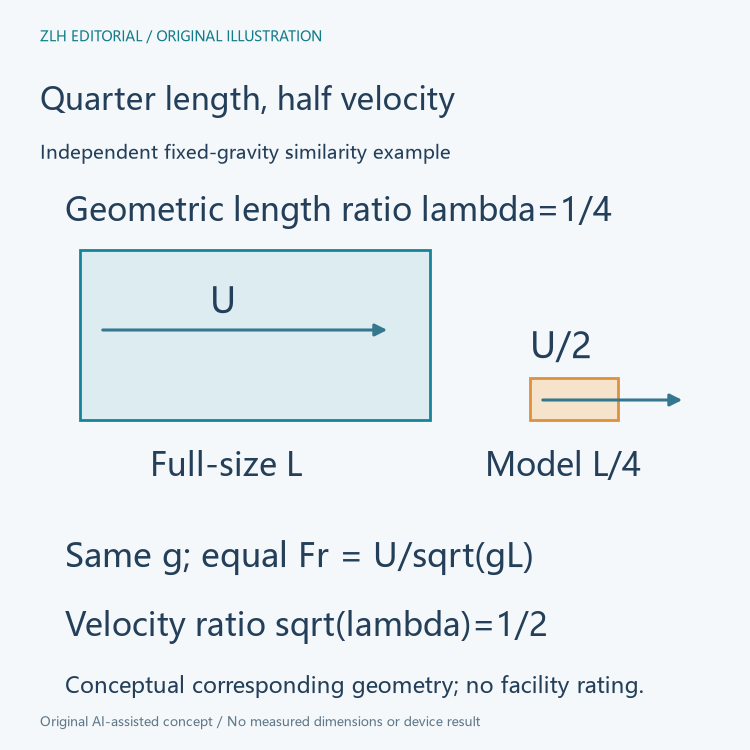
Match the number and derive the velocity ratio
Write the model-to-full-size length ratio as lambda = Lm/Lp. Let both models experience the same gravitational acceleration. Setting Um/sqrt(g Lm) equal to Up/sqrt(g Lp) gives Um/Up = sqrt(lambda). The subscript p denotes the full-size reference, while m denotes the reduced model.
Choose an independent lambda of one quarter. The corresponding velocity ratio is one half. For example, if the full-size characteristic velocity is represented by a symbolic U, the model's corresponding velocity is U/2. No absolute velocity is needed to verify the scaling.
Using a velocity ratio of one quarter instead would produce a model Froude number only half the full-size value. Merely reducing every numerical quantity by the length factor does not maintain the stated inertia-gravity comparison. The dimensionless equation determines which powers of lambda belong to each quantity.
Time and volume flow have different scale powers
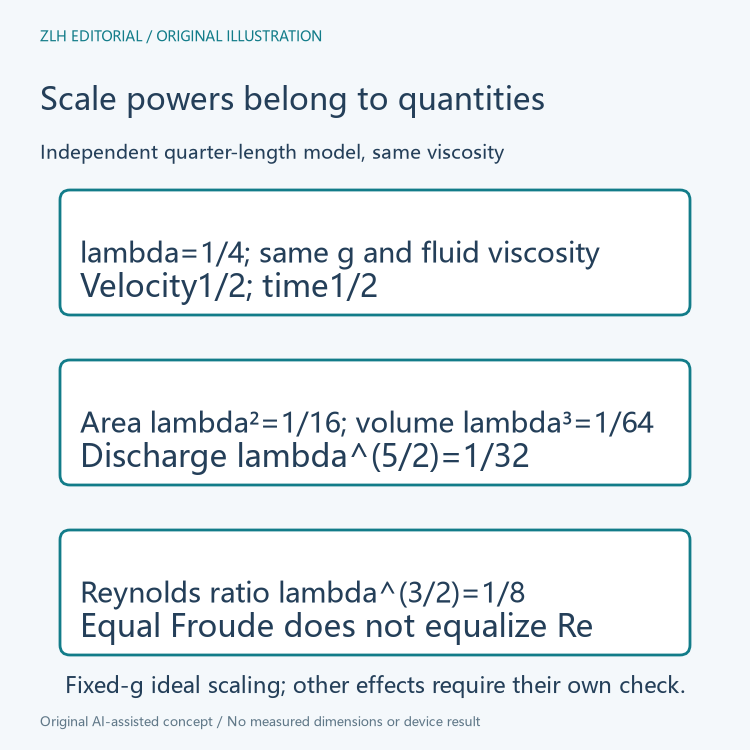
A corresponding transit-time scale is L/U. Its model-to-full-size ratio is lambda divided by sqrt(lambda), or sqrt(lambda). With the quarter-length example, a corresponding transit event takes half as much model time. This relation describes corresponding kinematic scales, not an instruction to alter the frame rate of a recording without retaining its time metadata.
Corresponding cross-sectional areas scale as lambda squared under geometric similarity. Volume flow scales as area times velocity, so Qm/Qp = lambda^(5/2). For lambda equal to one quarter, the ratio is one thirty-second. A smaller length, a smaller area and a smaller velocity contribute different factors to that result.
The ideal volume scale itself is lambda cubed, or one sixty-fourth here. Dividing volume by the half-size time scale again gives one thirty-second for volume flow. This independent check confirms that the flow ratio is not simply the volume ratio.
Reynolds similarity does not follow automatically
The Reynolds number is Re = U L/nu, with nu the kinematic viscosity. If both geometries use fluid with the same kinematic viscosity, the Reynolds ratio under the Froude velocity scale is lambda^(3/2). For the quarter-length example that equals one eighth, not one.
Thus this reduced model cannot simultaneously preserve both numbers with the same viscosity and gravitational acceleration. Algebraically, preserving Reynolds number as well would require a model viscosity ratio of lambda^(3/2). That is a compatibility condition, not a recommendation to choose or prepare a particular fluid.
The Bureau of Reclamation cautions that differences in friction losses must be insignificant or accounted for. Matching a chosen number therefore needs an accompanying statement about which other effects matter. Surface tension, roughness and other physical conditions can also influence whether a simple gravity-dominated comparison represents the intended situation.
Retain definitions with any training-model comparison
A report can identify its length definition, geometric scale, gravity assumption, fluid state and the dimensionless conditions being compared. In an open channel, hydraulic mean depth is related to cross-sectional area and surface width, which should not be confused with the wetted-perimeter hydraulic diameter used in a different flow context.
The independent quarter-length ratios explain why corresponding velocity, time, volume and discharge have different powers. They do not establish predictive accuracy for a real reduced model. Related reading appears in engineering similarity principles and robotics learning resources. Primary references: Cimbala's dimensionless-parameter table and the Bureau of Reclamation's model-similarity explanation. Both original AI-assisted figures show symbolic scale arithmetic, not experimental flow visualization.