

Indexed Choice Arrays: Labels, Positions and Range Modes
2026-11-21
Indexed Choice Arrays: Labels, Positions and Range Modes
Indexed choice arrays select a candidate array by integer label at each output position. NumPy choose combines the selector and candidate arrays after broadcasting them to a common shape. The selector values identify which candidate supplies a value; they are different from Boolean conditions tested in a priority order.
An integer label names one candidate
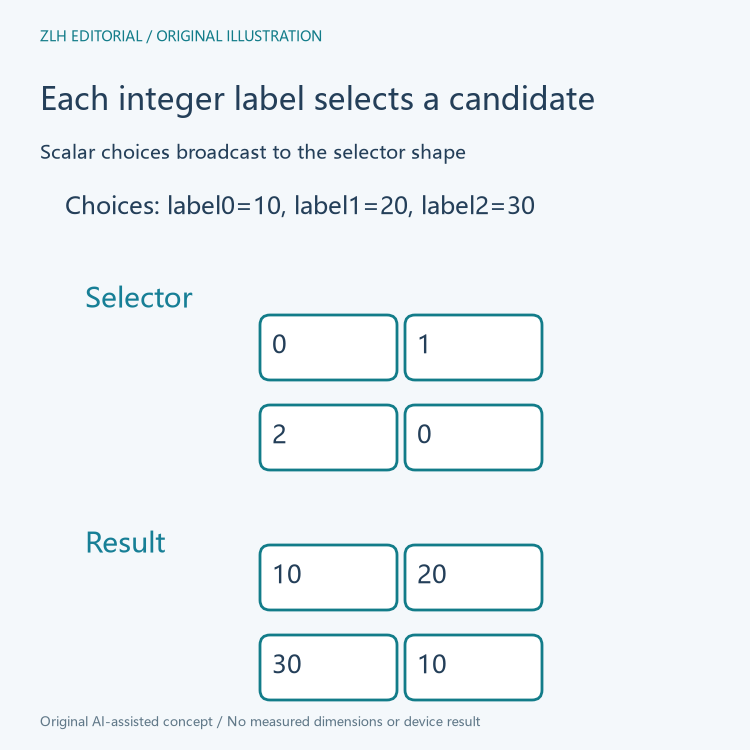
The NumPy choose documentation defines a selector array and a sequence of choice arrays. Use the invented selector matrix with rows zero, one and two, zero. Provide three scalar choices ten, twenty and thirty.
The scalars broadcast across the selector's two-by-two shape. Label zero selects ten, label one selects twenty and label two selects thirty. The resulting matrix has rows ten, twenty and thirty, ten, preserving the selector's coordinate arrangement.
These labels are positions in the supplied candidate sequence, not values searched for inside the candidate arrays. A selector value two does not ask for an input element equal to two, nor does it identify the second row of the selector matrix.
Candidate values can also vary by output position
A scalar-choice example makes label meaning clear, but the general rule permits arrays. After broadcasting, each output position takes the value at that same position in the chosen candidate. The candidate index and the coordinate inside that candidate are separate parts of the selection.
For a one-dimensional invented selector zero, one, zero, use first candidate ten, eleven, twelve and second candidate twenty, twenty-one, twenty-two. The result is ten, twenty-one, twelve. The middle label one chooses the second candidate's middle value, rather than its first value.
The original candidate arrays are not concatenated into one long list and indexed by the selector alone. That mistaken model would lose the matching output coordinate, producing a different operation from the one the documentation defines.

The mode controls out-of-range labels
The default raise mode requires labels from zero through the number of choices minus one. With three choices, a label three is outside the permitted range and the local check records ValueError. A negative label is also outside that default range.
Wrap mode maps labels modulo the number of choices. For three candidates, three maps to zero and negative one maps to two. Using scalar choices ten, twenty and thirty, the invented label pair negative one, three therefore selects thirty, ten.
Clip mode instead maps negative labels to zero and overly large labels to the final candidate. The same label pair selects ten, thirty. Wrap and clip thus differ even though both allow the original out-of-range integers to be supplied.
Label clipping differs from clipping numeric data
In choose, clip mode limits candidate labels before selection. It does not clamp the chosen numeric values to an interval. If the final candidate contains thirty, mapping an excessive label to that candidate returns thirty without comparing thirty with the label boundary.
The phrase clip can therefore describe different roles in different interfaces. A review should preserve whether the quantity being limited is a data value or an index into candidate choices, rather than treating the shared word as evidence that the transformations are interchangeable.
The original NumPy choose wrapper forwards the candidate sequence, output and mode into the array method. This inspection confirms the argument flow; the documented selection and mode semantics come from the full public API description.
Broadcast compatibility is necessary but not semantic validation
All inputs must broadcast to a common shape. Compatibility errors are different from out-of-range label errors. Even a successfully broadcast arrangement still needs meaningful coordinate labels if its candidates represent real data fields.
A second shape example makes the common-coordinate requirement concrete. A selector with shape two by one contains zero in its first row and one in its second. Candidate rows one, two, three and four, five, six each have shape one by three. Broadcasting produces a two-by-three result whose first row is one, two, three and whose second row is four, five, six.
The selector contributes the row-dependent choice while each candidate contributes its column-dependent value. Neither input shape alone describes the final arrangement. Keep both candidate shapes and selector shape in the example record, so the resulting two-dimensional table is explained by their combined roles rather than a presumed flattening order. Each output coordinate still identifies exactly one candidate value.
The local tests use invented integers to verify the two-by-two scalar example, the varying-candidate example and the two out-of-range modes. No learning model, equipment channel or actual record is selected. Related explanations appear in the array selection methods section and the technical article collection.


