

Selective Suppression: Resume After the Managed Block
2026-11-21
Selective Suppression: Resume After the Managed Block
Selective Suppression allows a with block to finish when it raises an exception of a specified type. The phrase finish needs care: execution resumes after the managed block, rather than returning to the failed statement or continuing through later statements inside that block. Matching an exception is therefore both a type decision and a control-flow decision.
Mark the statement that raises and the statement after the block
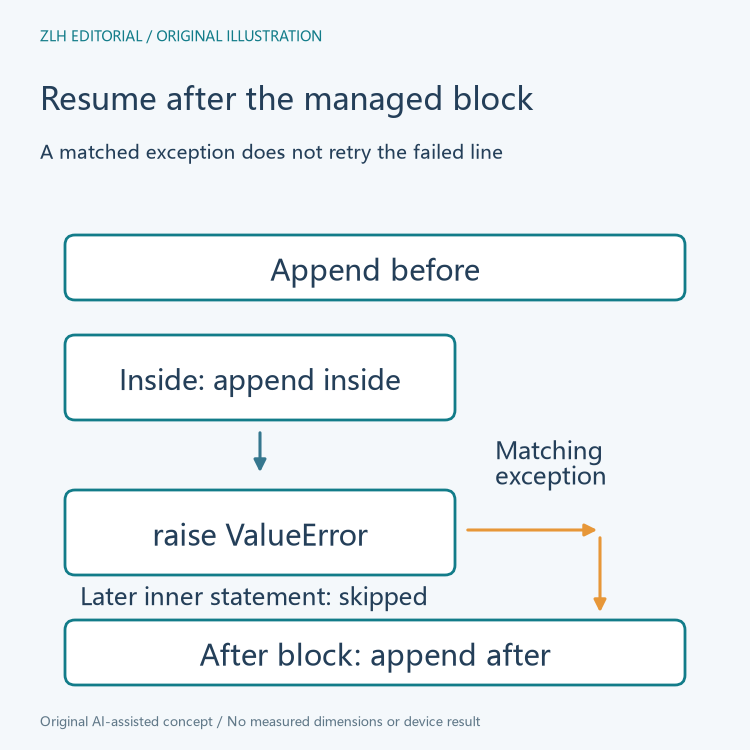
The Python contextlib reference describes suppress as a context manager that suppresses specified exceptions and resumes execution with the first statement following the with statement. Consider an event list initially containing before. Inside suppress(ValueError), append inside, raise an illustrative ValueError, and place another append called unreachable after the raise.
After the managed block, append after. The final list is before, inside, after. The unreachable append never runs. A local check reproduced this exact event sequence. Suppression handles the raised exception as control leaves the block; it does not repair the failed statement and jump back into the middle of the block to execute its remaining lines.
Only matching exception types are handled
Specifying ValueError is not an instruction to ignore every error that could occur in the body. An unrelated exception type can propagate. The type relationship matters as well: ordinary exception subclasses can match a specified superclass. A reviewer should therefore identify both the expected failure and the scope of the managed block instead of treating the context manager as an unconditional success marker.
The versioned reference implementation makes the ordinary path explicit in suppress.__exit__. With no exception, there is no exception to handle. If the raised exception type is a subclass of one of the specified types, the method returns true to indicate suppression. Otherwise the ordinary unmatched exception is not handled by that branch.
Suppression does not undo work already completed
In the event-list example, inside remains present after the ValueError is suppressed. That append happened before the failure and has not been rolled back. The context manager is not a transaction mechanism for arbitrary preceding changes. If an application needs restoration, it requires a separate, explicit design appropriate to the affected state.
Nor does suppress request a retry. Repeating an operation would require another call or a surrounding loop written by the application. The exact result of suppression is narrower: a matching exception does not continue outward, and execution proceeds after the with statement. Keeping this boundary visible prevents a diagram from suggesting either a backward retry arrow or a continuation arrow to the next inner statement.
The event log also separates absence of propagation from completion of every inner statement. A caller that sees no outward exception still cannot conclude that unreachable ran. Recording the expected resumption point is more informative than recording only that the surrounding function eventually returned normally.
An exception group can leave an unsuppressed remainder
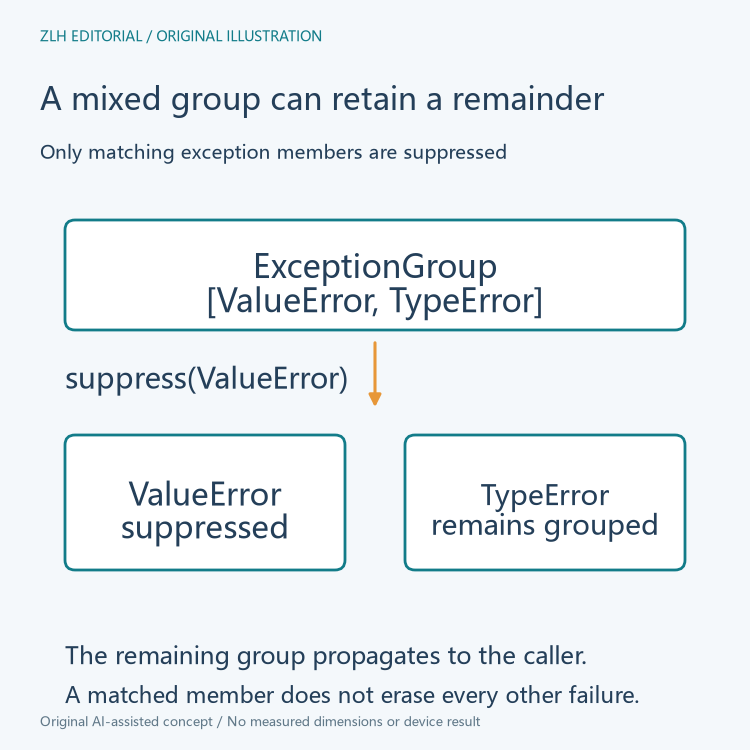
The reference documents support for BaseExceptionGroup beginning with Python 3.12. When such a group contains matching and nonmatching members, the matching members can be suppressed while a new group containing the remainder is re-raised. This is different from declaring the entire grouped operation successful because at least one member matched.
For a small local example, build an ExceptionGroup containing a ValueError and a TypeError, then place its raise inside suppress(ValueError). The surrounding check receives a remaining group whose member type is TypeError. The ValueError member has been removed from the propagating remainder, but the unrelated member still reaches the caller. The example deliberately keeps the group shallow so its membership can be read directly.
The implementation uses the group's split operation with the specified exception types, and re-raises the remaining part when it is not empty. That retains group behavior rather than flattening unrelated failures into a single ordinary exception. Detailed applications may contain nested groups, so they should interpret the resulting structure rather than assuming every failure arrives as one directly raised leaf.
Draw a narrow boundary around the expected failure
Because a matched exception exits the whole managed body, adding unrelated statements to that body can change what gets skipped. A review should show which statements precede the possible failure, which follow it inside the block, and where normal execution resumes outside. That trace makes the cost of a broad block concrete without inventing a policy for the application's error handling.
The technical learning collection and equipment software notes provide related programming context. All events and exceptions here are locally constructed teaching examples. The original figures show the resumption point and a mixed group's surviving member. They do not claim that suppressed errors restore earlier state, repeat an operation, validate a device result or imply that every independent part of a grouped operation succeeded.


