

Memory Overlap: Exact Sharing and Bounds-Only Tests
2026-11-18
Memory Overlap: Exact Sharing and Bounds-Only Tests
Memory Overlap is a question about storage locations, rather than about whether two arrays display the same values. Two views can belong to the same original allocation while selecting disjoint bytes. A quick bounds check may still report that sharing is possible because the smallest enclosing address intervals intersect. Separating those two tests explains why a possible-sharing result should not automatically be read as proof of an actual shared element.
Build interleaved views with disjoint selected bytes
Create a one-dimensional array of eight unsigned one-byte integers, with illustrative values zero through seven. Let even=base[::2] and odd=base[1::2]. The even view selects byte offsets zero, two, four and six from the start of the allocation. The odd view selects offsets one, three, five and seven. Neither selected byte belongs to both views, even though they share the same base allocation.
The NumPy shares_memory reference documents that its default exact mode returns True only when the arrays actually overlap. Its examples specifically distinguish a view from its entire source and an even-position view from an odd-position view. For this byte-sized construction, shares_memory(even,odd) is False, while shares_memory(even,base) is True.
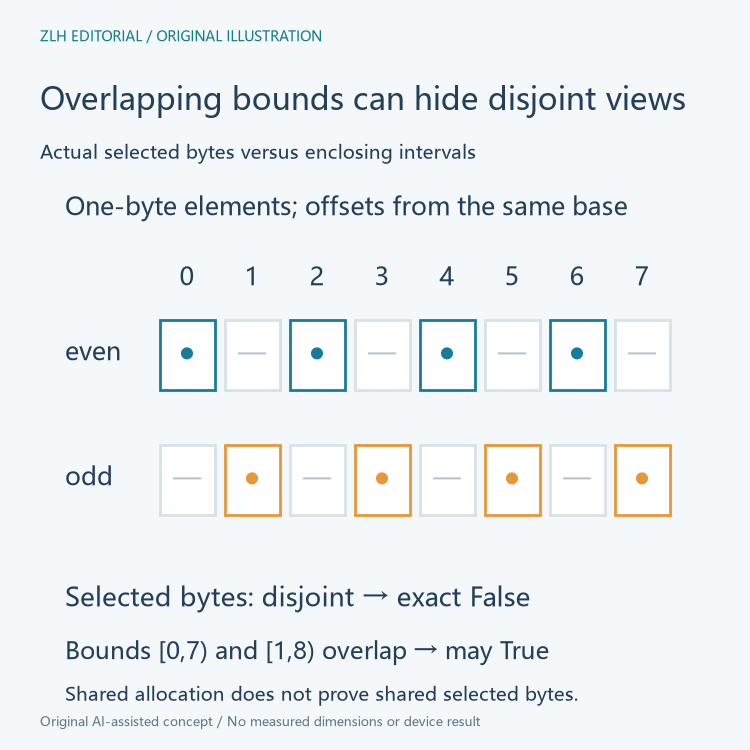
Enclosing address intervals can overlap without selected bytes overlapping
The even view's enclosing half-open byte interval runs from offset zero through the end of byte six, written [0,7). The odd view's interval is [1,8). These intervals intersect, although the individual selected offsets alternate. A bounds-only test can see the intersecting envelopes without proving an equality between selected addresses.
The may_share_memory reference explicitly says that a True result does not necessarily mean a shared element exists. Its default uses memory bounds. Thus may_share_memory(even,odd) can be True for the construction above while the exact test is False. This is the intended conservative distinction, rather than contradictory answers to an identical question.
Use a second pair to show actual overlap
Now take v=base[2:6] and w=base[4:8]. The first selects offsets two through five, and the second offsets four through seven. Offsets four and five belong to both. In this case the exact overlap test is True. Setting v[2] to ninety-nine changes the element at base offset four, which is also w[0]. This is a specific shared location that can be named and checked.
By contrast, setting even[0] changes only base offset zero and does not alter an element selected by odd. The absence of cross-view changes in that simple write follows from their disjoint selections, not from either view owning a completely separate allocation. Be precise about which other view is being observed when using mutation to illustrate storage relationships.
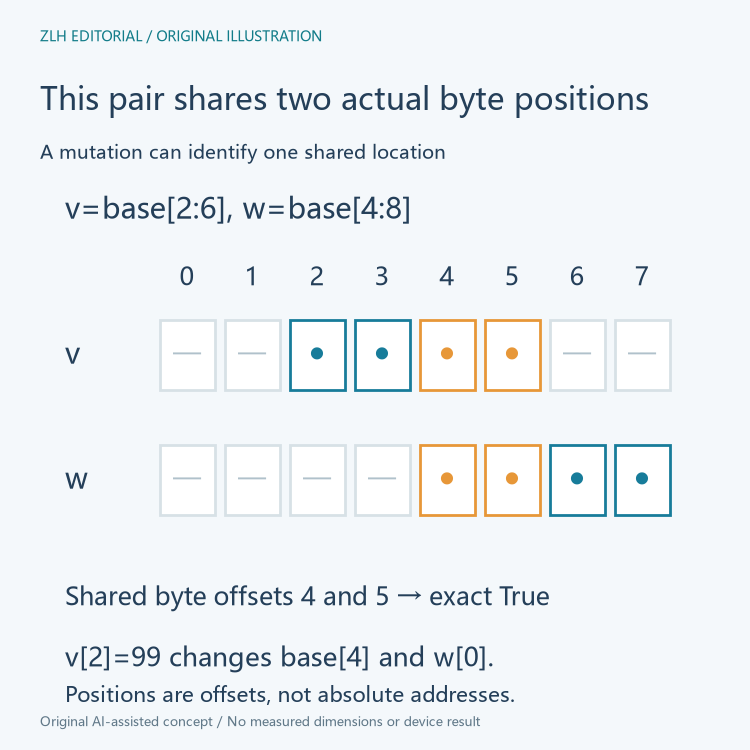
The one-byte dtype makes each marked offset a complete element region. With wider dtypes, an element occupies several consecutive bytes, and an address diagram must draw that width rather than mark only its starting point. Different views can also interpret a buffer with different dtypes. The comparison still concerns the selected storage regions, so identical numeric index labels in two separate views are not sufficient evidence that those labels identify the same underlying bytes.
Exact overlap can require more work than inspecting shapes
The exact function accepts max_work to limit the effort spent solving the overlap problem. Its default requests an exact solution; zero selects the bounds-only behavior. A positive limit can lead to TooHardError if the allowed work is exceeded. That exception is not a negative overlap answer. It reports that the requested computation did not settle the question within the given allowance.
The documentation notes that difficult stride configurations can make exact checking extremely expensive. There is no need to construct such an array to understand the distinction here: the original eight-byte example is deliberately small. The useful lesson is to record whether a result came from the exact mode or a conservative bounds check, and to keep an inconclusive work-limit outcome separate from both True and False.
Aliasing does not describe equality, ownership or write permission
Two separately copied arrays can contain identical integers and still have no overlapping storage. Conversely, two overlapping views can display different sequences because their selected positions and shapes differ. A shared base reference alone also does not establish selected-byte overlap, as the even and odd views demonstrated. Inspecting values or a single ownership attribute therefore answers a different question.
Write permission is another property: a read-only view can overlap another array even though writing through that view is disallowed. These tests concern the arrays' storage, not whether objects referenced by object-dtype entries share an arbitrary nested object graph. The technical learning collection and equipment software pages can place these examples in context. The original illustrations establish selected byte positions and test meanings, without claiming an application memory leak, corruption event or measured runtime.


