

Accelerometer Cross-Axis Sensitivity: Reading the Error
2026-11-09
Accelerometer Cross-Axis Sensitivity: Reading the Error
An accelerometer can report a small signal on its X output even when a test fixture applies acceleration only along the package Y direction. Accelerometer cross-axis sensitivity is a specification for that kind of coupling. The direction being measured and the direction of the applied acceleration are different. The result tells the reader how strongly an input on one axis can contribute to a reading on another axis.
Identify the input and output axes in that order
Analog Devices defines cross-axis sensitivity using a stimulus orthogonal to the intended sensing axis. An X channel, for example, is intended to respond to acceleration along X. A test can apply acceleration along the perpendicular Y direction and observe the change in the X output. Describing the result as “X response to Y input” makes the direction of the relationship explicit. The opposite test, Y response to X input, is a separate case.
A triaxial device has three channels, and each channel can have more than one perpendicular input direction. The technical guide identifies applied Y and Z acceleration in its explanation of an X-axis reading. A datasheet may summarize the result or state separate terms. Before interpreting a percentage, identify the output, the imposed direction and the particular definition used by that manufacturer.
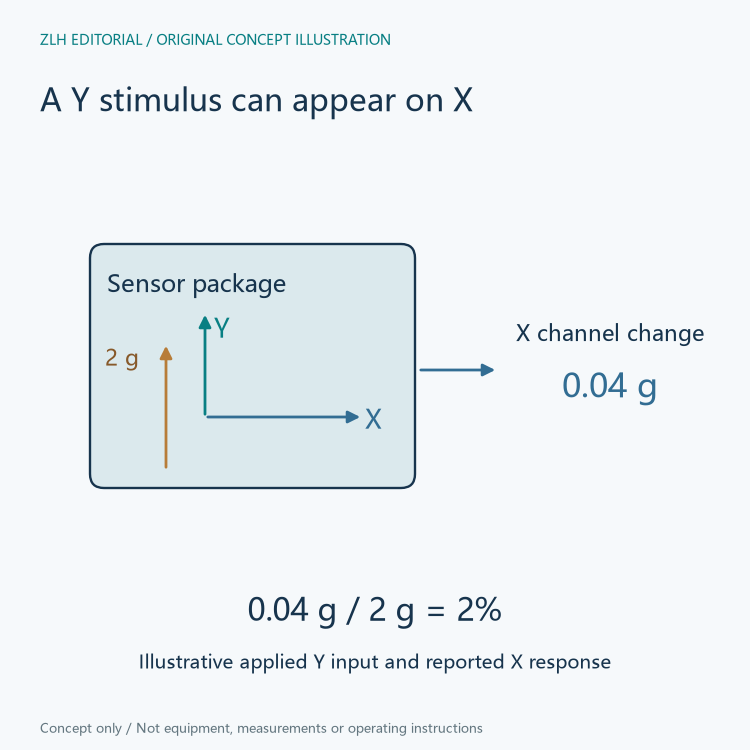
A percentage compares response to the applied stimulus
Suppose a hypothetical package receives a Y input of two g, where g is the unit based on standard gravity. In this illustration the X channel changes by an amount equivalent to 0.04 g when expressed using its X sensitivity. The ratio is 0.04 divided by two, or two percent. The denominator is the applied Y stimulus, not the size of the X reading. The example works with a change in reading so a fixed starting offset is a separate quantity.
A voltage-output instrument can describe the result by comparing a transverse sensitivity with the main-axis sensitivity, as in the NI ZonicBook reference. Suppose a sensing axis produces 100 millivolts per g under an axial input. A transverse response of two millivolts per g under comparable conditions is two percent of that slope. If the report already expresses both quantities as equivalent acceleration, the conversion from voltage has already been applied. Both ways of reporting refer to a response measured under defined stimulus conditions.
A simple linear model writes the X reading as the sum of a main-axis term, an off-axis term for Y, another for Z, and an offset. Each response coefficient multiplies the corresponding acceleration component. A zero-input reading addresses the offset. It cannot reveal whether the X reading changes with Y input, because the Y term is zero in that observation. Conversely, a reported two percent cross-axis response does not say that the X sensitivity itself has a two percent error. These fields describe different pieces of the sensor response, even if several are reported as percentages.
The package and the mounting structure set different reference frames
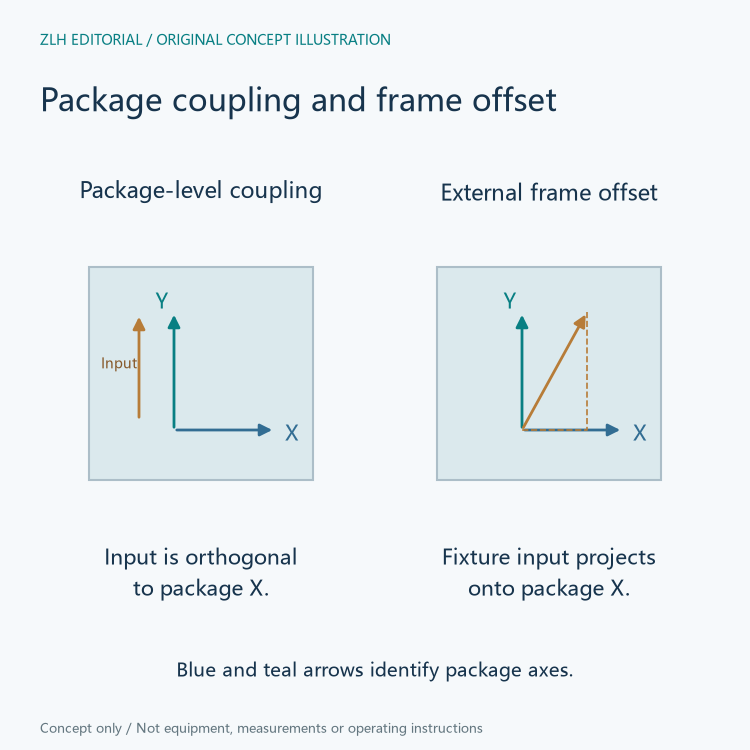
Analog Devices distinguishes device-level cross-axis contributions from system mounting. Its ADXL guide includes effects from sensor fabrication and alignment of the sensing structure within the package in its device definition. Alignment between the package and the circuit board, or between the board and the larger mechanism, belongs to a separate level. A package axis and a robot body axis can point in different directions even when the sensor inside the package is ideal.
Imagine a fixture whose machine Y direction is slightly tilted relative to the sensor's package Y direction. Acceleration applied along that fixture direction has a component along package X. An ideal sensor would correctly report that component. In a different test, the applied input is perpendicular to package X itself, but the X channel still changes. This second observation is the one used to explain the device cross-axis term. Both effects can appear in a measured signal unless the frames and applied direction are known.
Frequency and test context belong with the number
The NI reference explains that transverse sensitivity can vary with angle and frequency. A result attached to a given excitation and mounting context has more meaning than a bare percentage. Likewise, a small parasitic term can be noticeable when the perpendicular vibration is much stronger than the motion of interest. The percentage describes a relative response to that perpendicular input. It does not by itself establish how much spurious acceleration will appear in a particular operating trace.
For a vibration record, keep the sensor package axis, machine axis and applied direction visible alongside the channel. A measurement taken while the input direction is unknown may show a real acceleration component, device coupling, or a mixture. In contrast, a result with an identified orthogonal input can be compared with a cross-axis specification using its stated scope. This is the difference between observing two channels at once and knowing which direction generated each part of the reading.
Related material appears in the robot sensor reference and technical article directory.
Primary sources. Analog Devices ADXL guide, cross-axis sensitivity and device-level alignment. NI ZonicBook original manual, accelerometer sensitivity and transverse response.


