
Capstan Equation: Why Wrap Angle Changes the Tension Limit
2026-11-09
Capstan Equation: Why Wrap Angle Changes the Tension Limit
The Capstan Equation describes the largest ratio of end tensions that an ideal flexible line can sustain around a rigid cylinder before it slips. The ratio depends on the coefficient of static friction and the angle through which the line wraps around the cylinder. The result follows from many small friction limits along the curved contact, each of which depends on the tension already present at that location.
Wrap angle measures the turn made by the line
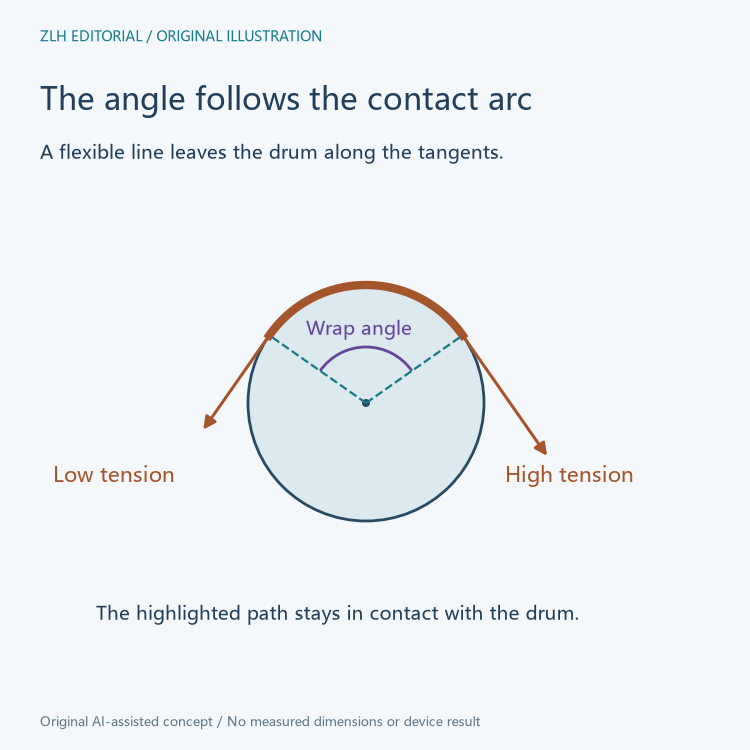
In MIT's worked capstan example, the line touches a circular drum between two ends of a contact arc. Its two free segments leave the surface in tangent directions. The wrap angle is the angle swept around the center from one end of the contact arc to the other. It is measured in radians when used in the equation. An arc length and a wrap angle describe different parts of the geometry. Changing the radius changes the arc length for a given angle, while the classical ratio is expressed in terms of the angle.
A side view can show the two free line segments and a pair of radii running to the places where contact starts and ends. Those radii bound the angle swept along the contact. A drawing should identify the actual contact path if the line turns farther than the smaller angle visible between the two radii.
The normal force follows the changing line direction
Consider a small segment within the contact. Tension pulls along the local tangent at each end. Even if the two magnitudes are close, their directions differ because the line curves around the cylinder. The difference in direction produces a component directed toward the center. The cylinder pushes outward on that small segment to balance it. In the flexible line model, the outward contact force is approximately the local tension multiplied by the small angle swept by the segment.
The maximum static friction on that segment is the contact force multiplied by the coefficient of static friction. A segment at a higher local tension has a larger normal contact force for the same small angle. It can therefore support a larger absolute change in tension before sliding. This local dependence explains why equal angle increments at the threshold give equal changes in the logarithm of tension.
An exponential ratio describes the threshold
MIT writes the lower tension as the higher tension multiplied by an exponential with a negative exponent. The same relation can be written as the higher tension divided by the lower tension equals e raised to the product of the static friction coefficient and the wrap angle. This equality describes the onset of sliding in the model. At a smaller ratio, the tangential contact forces need only take the values required to keep the line stationary, within the static friction bound.
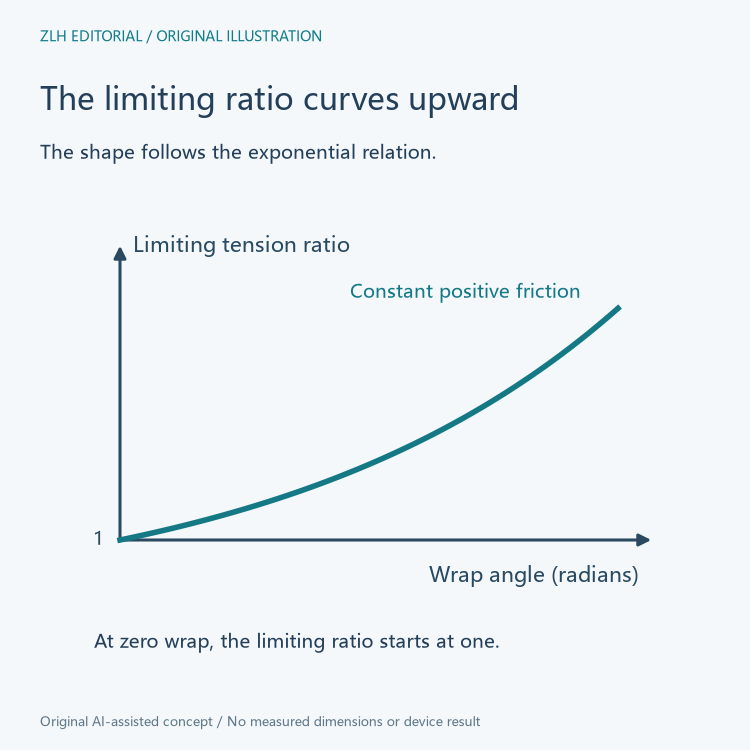
With the coefficient held constant, adding the same wrap angle a second time multiplies the limiting ratio by the same factor a second time. A plot of the logarithm of the limiting ratio against angle would therefore be a straight line through zero for this model. A plot of the ratio itself starts at one and curves upward. The two plots tell the same story using different vertical scales.
The classical contact geometry assumes a very flexible line
Harmeet Singh's research on elastic rods starts from the classical equation and distinguishes it from a rod with finite bending stiffness. In the classical geometry the free segments follow the tangent directions at the actual ends of contact. In the elastic rod problem, the rod can bend near the contact boundary, so the angle implied by the end forces and the angle in contact with the cylinder can differ. The study treats those contact boundaries as part of the mechanics to be solved.
The classical form is useful for seeing what distributed static friction can do when the line is fully flexible and the drum is rigid and circular. To read a technical drawing alongside the equation, identify the high and low tensions, the arc actually in contact, the friction model, and whether the calculation represents a limiting equilibrium. These details distinguish a modeled ratio from a pair of forces observed under ordinary conditions. See the mechanical technology archive and the technical article directory for related reading.
The ratio is dimensionless, so the two tension values must use compatible units before they are divided. The model also gives a useful check on the sign of the exponent. With zero friction or zero wrap, the threshold ratio is one. Increasing either positive input raises that threshold above one.
Primary references
See the MIT classical mechanics worked capstan example and Harmeet Singh's study of a rod wrapped around a circular capstan, particularly its introduction and Figure 1.