

Hot Isostatic Pressing: Gas Pressure and Closed Pores
2026-11-06
Hot Isostatic Pressing: Gas Pressure and Closed Pores
Hot Isostatic Pressing combines elevated temperature with gas pressure applied around a material. The abbreviation HIP identifies more than an ordinary heating step. KOBELCO and Aalberts explain how the pressure environment participates in densification, and why an isolated internal pore has a different relationship to the surrounding gas from a pore connected to the surface.
The furnace and the pressure vessel provide different conditions
Aalberts describes a furnace located inside a pressure vessel. The furnace provides the thermal environment, while the pressurized gas supplies pressure around the material. Its process explanation identifies inert gas, usually argon, as the pressure medium. Temperature and pressure consequently belong to one combined processing account.
KOBELCO likewise identifies gas pressure and elevated temperature as simultaneous conditions. A component photograph after heating cannot establish this full process identity. The information needed to call the treatment HIP includes the pressure environment as well as the presence of a thermal cycle.
Isostatic loading differs from a uniaxial punch
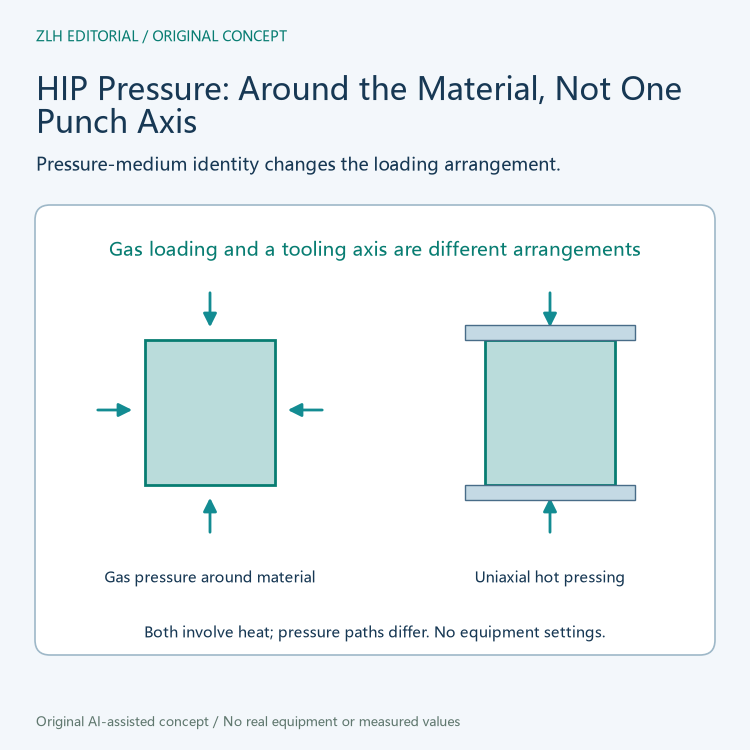
KOBELCO directly compares HIP with hot pressing. HIP applies pressure through gas around the material; conventional hot pressing applies pressure along one axis through tooling. Both involve heat and pressure, but their loading arrangements are physically different.
The manufacturer's explanatory example compares material with internal pores and material having uneven ends. A punch bears on projecting regions according to the tooling geometry. Gas pressure instead reaches the exposed surface from multiple directions. The first original diagram distinguishes those pressure roles without representing an actual press, die or component size.
Temperature enables material responses during densification
Aalberts attributes internal-void closure to the combined influence of plastic deformation, creep and diffusion bonding. KOBELCO also associates the contraction of its porous-material example with pore removal and diffusion effects. The mechanism therefore concerns changes within the material, rather than merely squeezing a visible outer contour.
This explanation should retain the material and treatment context. An account of these mechanisms does not specify how much each contributes in every alloy or ceramic. The applicable processing conditions depend on the material and intended result, rather than following from one universal temperature-and-pressure pair.
Closed internal pores differ from surface-connected passages
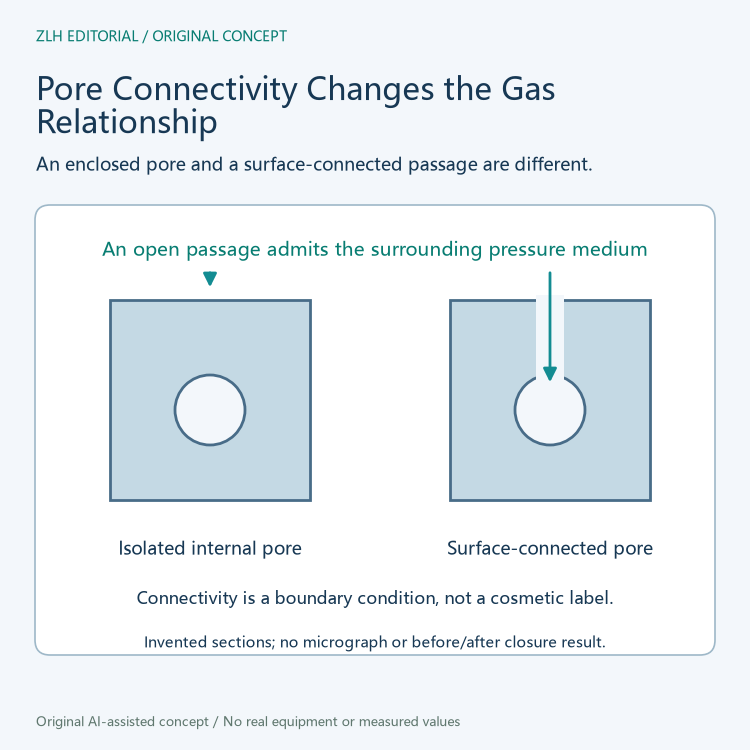
KOBELCO explicitly distinguishes isolated pores from open pores connected to the material surface. Its capsule-free explanation says closed pores can be reduced by HIP, while surface-connected pores are not closed in the same way. Aalberts repeats the boundary by specifying internal microporosity with no connection to the surface.
The gas path is therefore a central part of the explanation. A pore entirely enclosed by material and a passage open to the pressurizing environment may look like similar dark areas in a simplified section, yet they have different connections to that environment. The second illustration makes this connectivity visible.
A gas-tight capsule creates a separate powder-processing arrangement
KOBELCO describes the capsule method as enclosing powder or a powder-molded body in a gas-tight capsule and evacuating it before HIP. The capsule provides a boundary around the material being consolidated. This is a different starting arrangement from an already solid component whose remaining pores are isolated internally.
The manufacturer distinguishes that capsule method from capsule-free processing for suitable closed-porosity materials. The distinction prevents a loose powder illustration from silently being treated as though every powder particle already belonged to a gas-tight, fully enclosed solid component.
Retaining general shape does not mean zero dimensional change
KOBELCO's comparison describes HIP as broadly retaining the initial shape while the porous material contracts. Aalberts similarly notes that minor dimensional changes can accompany densification. General shape and exact dimensions are therefore separate descriptions.
Closing internal volume can be associated with a change in the component's outer dimensions. A conceptual account should preserve that relationship without supplying a universal shrinkage percentage. Neither an unchanged silhouette nor an invented before-and-after picture is a dimensional inspection result for a manufactured part.
KOBELCO also lists powder pressure sintering and removal of residual pores from sintered items as distinct applications. They need not begin with the same material state. In one account the powder is being consolidated; in the other, an already sintered body retains internal pores targeted by subsequent treatment.
Keep densification distinct from a finished-part acceptance result
The sources include castings, sintered materials and additively manufactured parts within their application accounts. Those starting routes identify different material histories. A useful equipment-learning record states the route, the closed-porosity or capsule condition and the combined pressure-and-temperature mechanism.
Related explanations appear in the materials processing collection and industrial equipment directory. The drawings show pressure and pore-connectivity concepts, without a processing recipe, a measured density increase or a claim that every possible defect has been removed.
Sources: KOBELCO HIP equipment and processing principles; Aalberts HIP process and pore limitations.


