

Rotational Molding: Powder Fusion Inside a Turning Mold
2026-11-06
Rotational Molding: Powder Fusion Inside a Turning Mold
Rotational Molding forms a hollow plastic product from material placed inside a hollow mold. In the powder-based process described here, heating and biaxial motion allow the polymer to melt and cover the mold's inner surfaces. Cooling then solidifies the material into a wall around the remaining central space. The mold, polymer charge and motion each have a distinct role.
The polymer starts inside the mold
LyondellBasell's official rotomolding overview explains the use of plastic powder and a mold heated while rotating about two axes. The powder becomes the material of the product. The mold provides the enclosing geometry within which that material is distributed.
Granger Plastics' original process description likewise begins with a measured amount of resin placed inside the prepared mold. This location matters: the material begins within the tool that will define the outer shape of the eventual hollow part, rather than arriving as a preformed finished shell.
Heating and movement work together
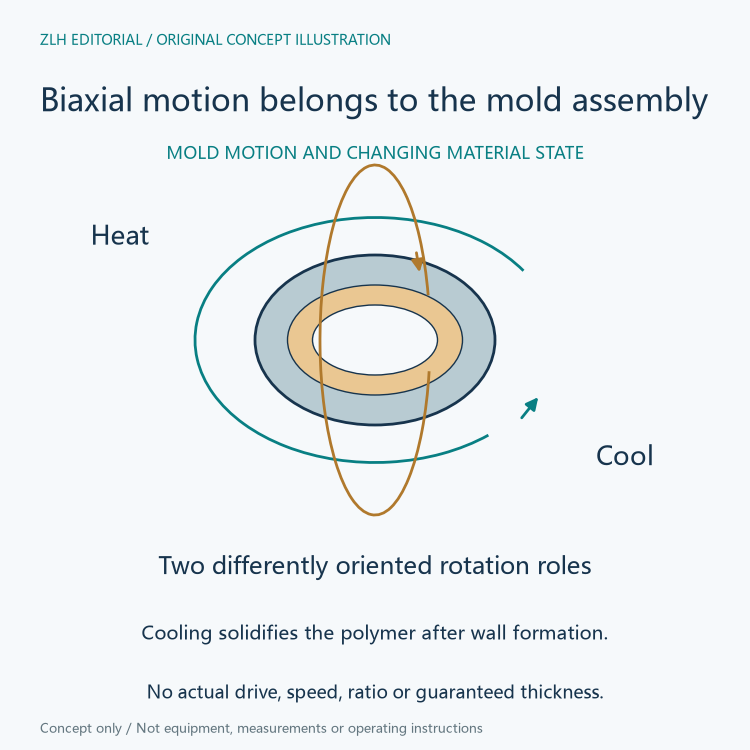
The Granger explanation describes the mold moving through a heating chamber while rotating about two axes at low speed. As the polyethylene warms and becomes fluid, it coats the inside of the mold and builds the part wall. LyondellBasell also connects the biaxial motion with melted plastic covering the mold's inner regions.
These descriptions identify two different contributions. Heating changes the polymer's physical state, while the changing mold orientation participates in distributing the material through the enclosed geometry. Naming rotation alone would omit the thermal change that allows the powder to become a connected wall.
A hollow product does not require a solid polymer centre
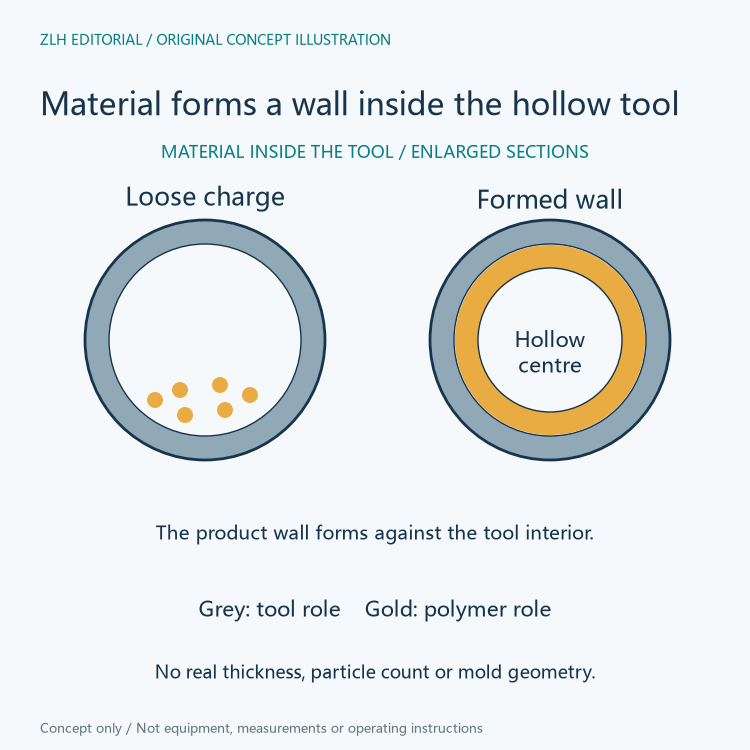
The material is used to form a wall against the interior of the tool. Once the cooled part is released, the space surrounded by that wall gives it a hollow form. The powder charge and the mold cavity therefore should not be illustrated as though the entire cavity were filled with a solid block of plastic.
This is a useful geometric distinction for learners. The mold's inside surface relates to the outside shape of the product, while the product wall surrounds its internal space. A simplified section can show those relationships without assigning a real wall thickness or suggesting that every feature will receive identical material distribution.
Cooling remains part of the molding cycle
Granger's four-stage overview describes cooling while the mold continues to rotate, followed by release of the molded part. LyondellBasell identifies cooling as the stage that solidifies the polymer. The motion is consequently not confined to a picture of a tool entering an oven; it also appears in the manufacturer's cooling description.
The material-state sequence matters when interpreting production photographs. A closed mold in a cooling chamber and a released polymer part show different objects at different stages. The metal tool still supplies the boundary in the former, while the cooled plastic wall has become the separate product in the latter.
Raw-material form and polymer identity both matter
LyondellBasell lists polyethylene pellets and powders among its materials for rotational molding applications. Granger's separate materials explanation discusses powder and micropellet forms and identifies polyethylene as a commonly used family. The polymer name and the form prepared for processing are therefore different pieces of information.
A supplier's pellet product and a powder charge in a process illustration should not silently become the same object. The materials page explicitly associates particle preparation with the process. Its broader list of polymers also shows why the powder-based polyethylene example should retain its material scope rather than become a description of every possible resin route.
Granger also explains that reducing some resins to a suitable particle form adds processing requirements. Its materials discussion consequently treats availability for rotational molding as more specific than availability as a general plastic. A material record can name the polymer family, prepared feed form and intended process together, without assuming that an arbitrary stock pellet is already the charge shown in the mold.
Rotation information needs the mold and material context
The Association of Rotational Molders' 2024 technical discussion of rotation connects rotation behaviour with mold size and the period before the powder has laid up. It also notes the lack of strong evidence for treating higher rotational speed as an automatic route to more even wall distribution.
That discussion helps distinguish a motion principle from a universal process result. Biaxial movement identifies an important relationship in the method, but a particular speed or ratio is not supplied by the process name. The tool geometry, material and stage of the cycle remain relevant to any more detailed description.
Further learning appears in the polymer manufacturing section and technical article directory. Following material inside the heated, turning mold, through wall formation and into cooling makes the origin of the hollow plastic part clear.


